

Incrementality Testing
Commute Zone Testing
Beyond State-Level Testing
Most geo testing splits the US into a small number of coarse regions — often just the 50 states. Coarseness is a real limitation: a single state can hold tens of millions of people, so holding one out is expensive, and matching test and control groups from only 50 units limits how precise the experiment can be.
Maxma Commute Zones are our proprietary geo unit built for measurement: roughly 600 zones covering the US, each one a self-contained local economy drawn around where people actually live, work, and shop.
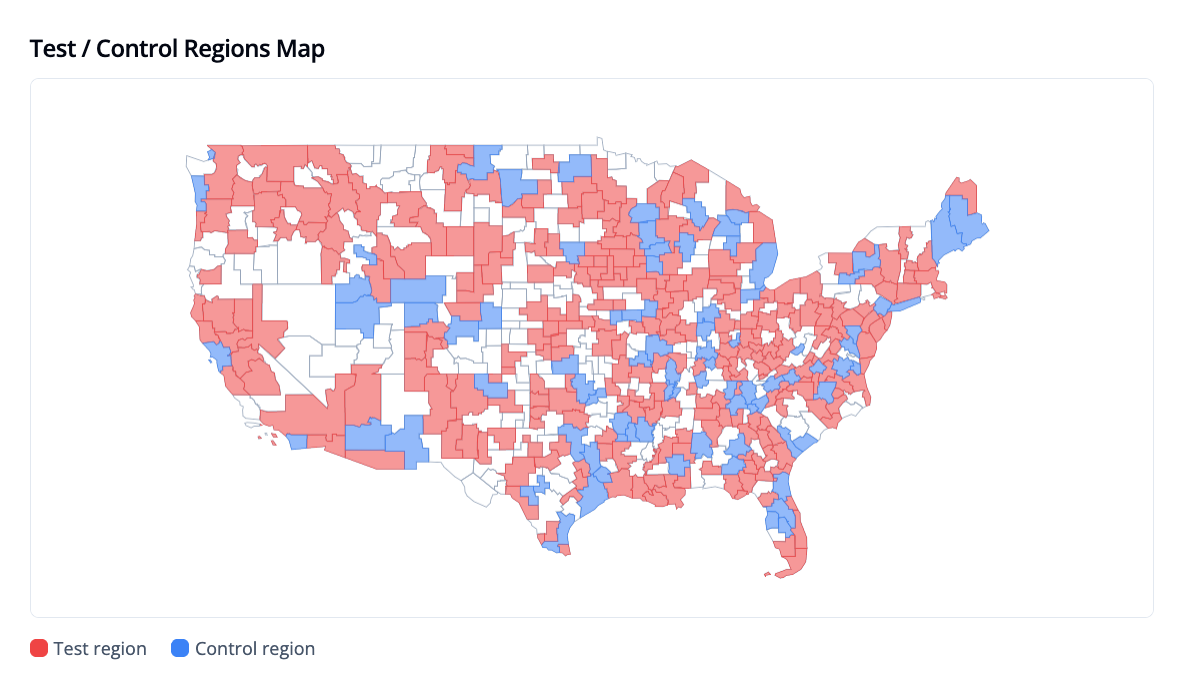
Why Self-Contained Matters
A geo experiment assumes ads shown in test regions don't influence buyers in control regions. Because commute zones follow real commuting patterns, people rarely cross zone boundaries in their daily life — which minimizes spillover between test and control and keeps the measurement clean.
What Finer Granularity Buys You
Higher accuracy and sensitivity. With more than ten times the units of a state-level test, Maxma finds much better-matched test and control groups. Better matching means less noise, which means the same test can detect a smaller lift — or detect the same lift with less budget and a shorter duration.
Smaller holdouts. Every region in the control group is revenue you're deliberately not advertising to — and not wanting to turn off ads in half the market is the most common reason teams never test at all. Coarse units force exactly that trade; with ~600 zones to select from, the power analysis can carve the control group down to often just 10–20% of the market while still yielding a statistically valid result. Testing stops feeling like a sacrifice.
Local campaign testing. If your business is concentrated in a handful of metro areas — or you want to test a regional campaign — coarse geo units can't form a valid experiment at all. Commute zones make local and regional experiments possible, so rigorous incrementality testing isn't just for national brands.
Choosing Your Geo Unit
Maxma supports three US geo units. Commute zones are generally recommended, but you can choose another unit if your test needs it:
- Commute zones — highest sensitivity, smallest holdouts, local testing
- DMAs — for national campaigns and platforms that only support DMA targeting (requires Nielsen DMA data)
- States — for coarse-grained tests or data that's only available at state level
Using Commute Zones
Maxma works from your conversion data at a granular geo level (such as city or ZIP code) and standardizes it into commute zones automatically — no manual mapping required. There are two ways to connect your data:
- Shopify — a one-click connection. Maxma pulls your data and processes it into commute-zone level automatically — you never upload anything. Amazon.com integration is coming soon.
- Database / S3 — for SaaS and other businesses where a one-click connection isn't available. Setup usually takes a technical team member about an hour; once live, marketers launch tests without any data pulls or processing for all future tests.
Commute-zone tests launch automatically on Google Ads and Meta Ads, with more channels coming soon. See Ad Platform Integrations for how automatic launch works.