

Marketing Mix Model
How Marketing Mix Model Works
Technical Foundation
Maxma MMM is powered by a proprietary algorithm that integrates the latest advancements from open-source tools, academic and industry research, and our own innovations.
High-level
As mentioned in Marketing Measurement Overview, Marketing Mix Model measures incrementality by modeling fluctuations in marketing activities relative to conversions without the need of tracking individual users.
Marketing Mix Model Measures Incrementality based on Fluctuations:
- In its simpliest form, if conversions rise and fall in correlation with increases or decreases in marketing inputs, the channel or tactic is likely driving conversions.
- The magnitude of these conversion changes relative to marketing inputs determines incrementality.
Why MMM doesn't need cookies?
MMM works with aggregated data rather than tracking individual users. It measures incrementality by modeling fluctuations in marketing activities in relation to conversions. Intuitively, if you consistently observe conversion values increase or decrease as you adjust marketing spend in specific channels or tactics, those activities are likely driving conversions incrementally.
Attribution Based On the Complete Picture
The incomplete picture of traditional attribution:
- If you rely on platform-reported conversions, you'll notice that different platforms compete for credit, often leading to duplicated conversion counts.
- Multi-touch attribution (MTA) tools from third-party vendors help slightly, but they still suffer from tracking limitations, as discussed in the Marketing Measurement Overview.
You can find more details in Why Traditional Attribution Is Unrealiable.
Why Marketing Mix Model Provides a More Complete View: The general advantages of Marketing Mix Model are:
- Considers the full picture: Marketing Mix Model accounts for all marketing activities as well as non-marketing factors that can impact conversion outcomes.
- Use complete and accurate aggregated data: If 10,000 impressions were delivered in California on Jan 1st, that data point is fixed and accurate, regardless of tracking issues.
However, most other MMM solutions using small data sources (e.g. weekly, country-level data) often have difficulty in isolating the impact of individual marketing activities.
Leveraging Large-Scale Geo-Location Data
Maxma takes a step further by using high-frequency, large-scale geo-location data to provide granular, timely, and robust incrementality measurements.
Why MMM powered by large-scale geo-location data is more powerful: Imagine having daily data on conversions and marketing inputs for hundreds of geographical areas. Even within a short period, the fluctuations across geographical areas and days provide a rich dataset to estimate the true impact of marketing inputs on conversions. However, tracking these movements and drawing meaningful insights manually would be overwhelming for humans - but ideal for statistical and machine learning models to make robust estimation. Maxma MMM does exactly that.
- Compared to most other MMM solutions, which often rely on weekly, country-level data, Maxma's approach uses daily, granular geo-level data, often 1,000x larger in data volume, enabling more robust and granular insights.
- Unlike tracking-based attribution, which follows individual users, Maxma's approach essentially analyzes audience cohorts across geographical areas, bypassing tracking restrictions.
| date | campaign | country | region | dma | impressions |
|---|---|---|---|---|---|
| 2024-01-29 | Bottom funnel | US | Alabama | Dothan, AL | 7 |
| 2024-01-29 | Discovery | US | Florida | Jacksonville, FL | 163 |
| 2024-01-29 | Non-brand | US | Delaware | Salisbury, MD | 20 |
How MMM Distribute Conversions To Marketing Drivers
With large-scale geo-location data, we can observe thousands of different combinations of marketing inputs and the resulting variations in conversions across geo locations and over time. This variation provides a rich dataset for estimating the incremental impact of each marketing activity. By regressing these relationships, MMM determines the incremental contribution of each marketing driver to the total conversion outcomes.
Input: Marketing Drivers Vary Across Channels, Geography & Time
Thousands of variations across different channels, geographic regions, and time periods
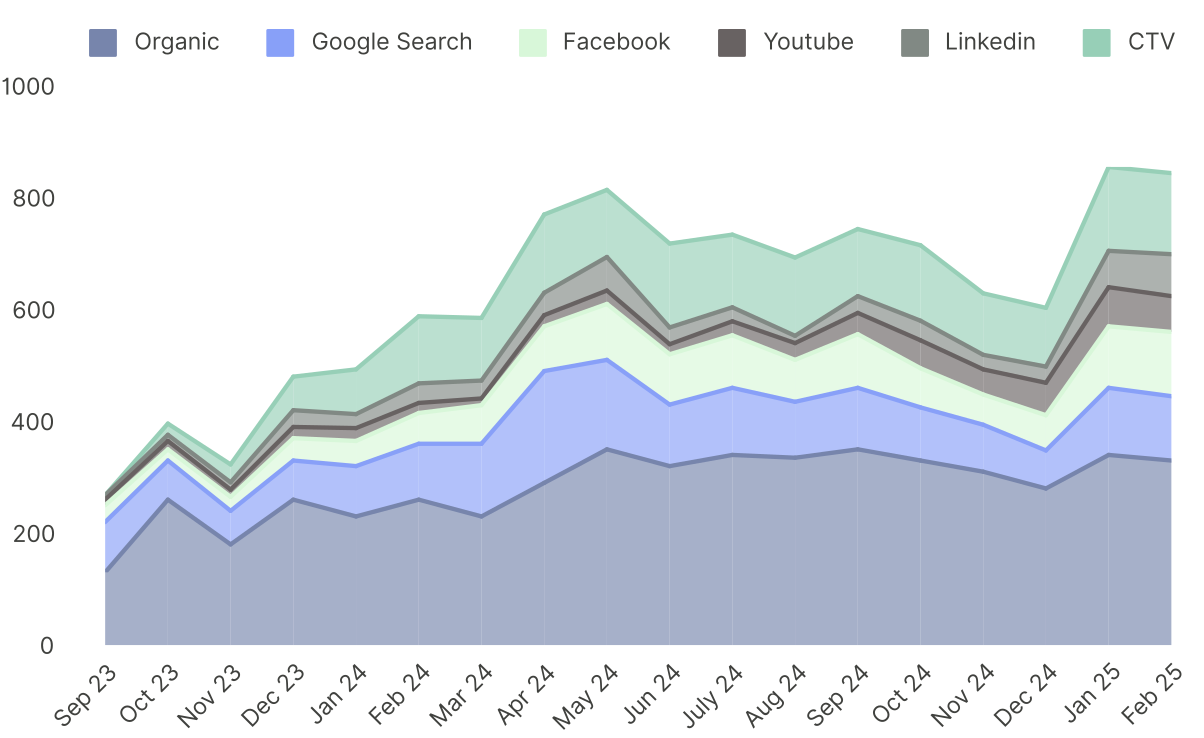
Output: Conversion Attributed To Marketing Drivers
The model regresses marketing driver variations against conversion variations to determine incremental contribution of each channel and tactic over time.
Adstock
Advertising effects are not always immediate—conversions can occur days or even weeks after exposure. In platform reporting, this is often handled using arbitrary lookback windows with a hard cut-off, which may not accurately capture the delayed impact.
Marketing Mix Modeling (MMM) addresses this using an approach called Adstock, which transforms raw marketing inputs to account for the gradual decay of marketing effectiveness over time. Maxma's algorithm detects the best-fitting decay pattern from the data. In practice, we often observe that top-of-funnel channels (e.g., Youtube awareness campaigns) tend to have a longer, slower decay, while bottom-of-funnel channels (e.g., retargeting) show a shorter, steeper decay in their impact.